Preparing for Passover
Have you ever wondered if the Feast Days of the LORD are still alive and relevant today, have you ever wondered how to celebrate them or if you even should?
Let’s dive in! First and foremost the heart of the believer in “Jesus” or Yeshua as he was known, kept His Father’s commandments and honored the Feast Days of Leviticus 23. The vital question is…do we?
The Lord spoke again to Moses, saying, 2 “Speak to the sons of Israel and say to them, ‘The Lord’s appointed times which you shall proclaim as holy convocations (NASB)
Think you’re not a ‘son of Israel’? The New Testament in Romans 11:17 begs to differ with your opinion:
But if some of the branches were broken off, and you, although a wild olive shoot, were grafted in among the others and now share in the nourishing root of the olive tree, 18 do not be arrogant toward the branches.
So, if we are grafted into the house, the house would have rules, and the question to ask yourself is …. am I following the rules?
For those brand new to walking in the footsteps of the Messiah, let’s begin by outlining the first Feast Day for the ‘new year’ according to our Father.
God’s calendar for Passover follows the biblical Hebrew calendar, a lunisolar system that aligns lunar months with the solar year to keep spring festivals (like Passover) in the proper season. Let’s see how that calendar works:
* The year has 12 lunar months (about 354 days), each starting at the new moon (first visible crescent after conjunction).
* Nisan (also called Aviv/Abib) is the first month of the religious year (Exodus 12:2), tied to spring.
* Passover begins on the 14th of Nisan (lamb slain in afternoon; meal after sunset, which then begins the Feast of Unleavened Bread on the 15th).
* Nisan 14/15 always falls near the full moon, since the full moon occurs around the 14th-15th of a lunar month.To prevent drift (lunar year shorter than solar year of ~365.25 days), an extra month (Adar II) is added in leap years (about 7 times every 19 years, following a fixed Metonic cycle in the modern calculated calendar).
This ensures Passover always occurs in spring, after the vernal (spring) equinox. The first full moon after the equinox typically lands in March or April on the Gregorian calendar (solar-based), depending on the exact timing of the equinox, new moon, and leap adjustments.
In short: Passover is fixed to the first full moon after spring begins (post-equinox), so it naturally falls in March or April most years, shifting slightly due to lunar-solar alignment. (For example, in recent years it has ranged from late March to mid-April.)
If you are used to using just the Roman solar calendar, read the above again, and maybe download the Hebrew Calendar to help you as we go forward. Don’t miss the next post! We’ll dive deeper.
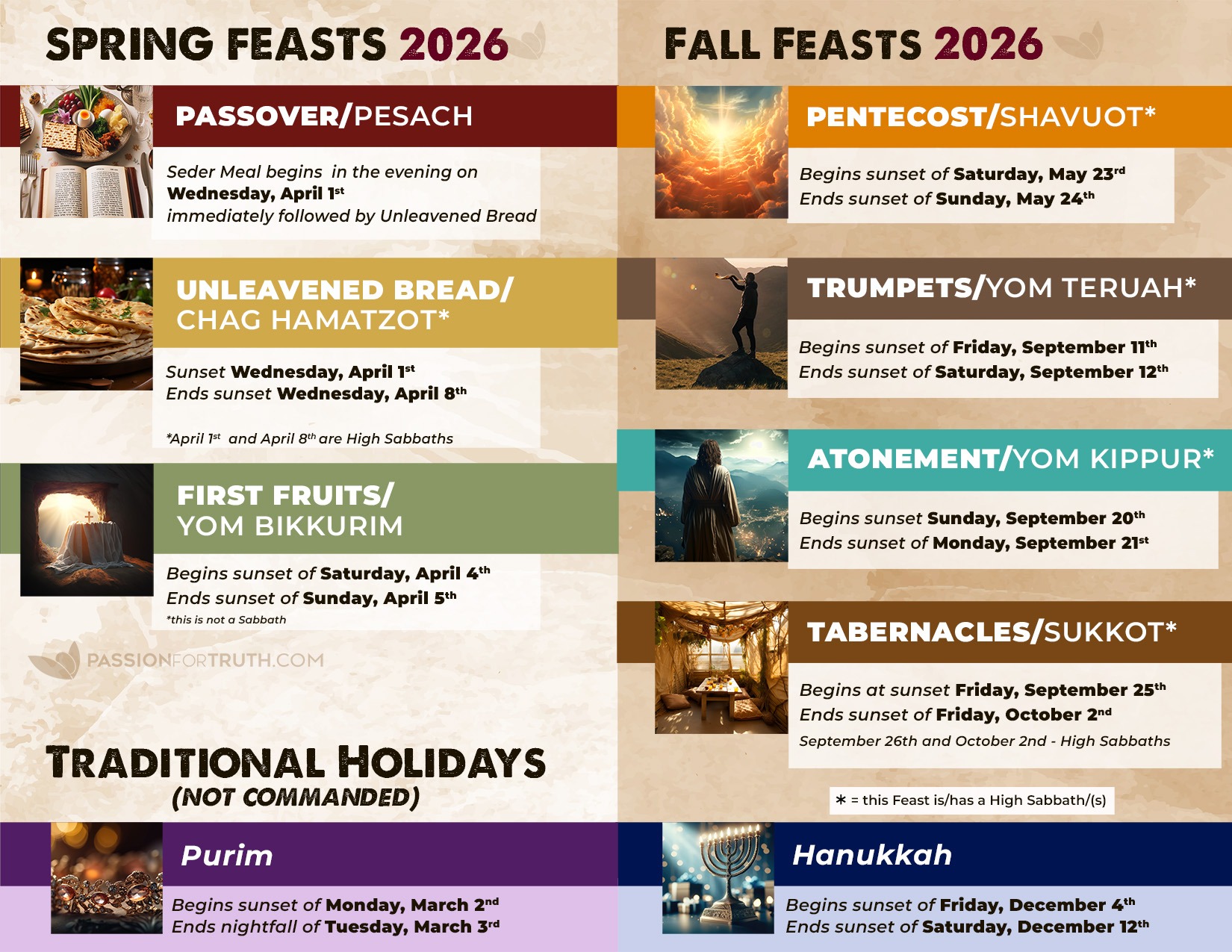
And, bottom, bottom line – Passover this year falls on the evening of April 1st, with the Seder meal – and immediately following is Unleavened Bread. Unleavened Bread ends on the evening of April 8.